 First Thing
Is waking at different times bad for your body clock?
The short answer
It can be. Getting up at about the same time every day keeps your body clock steady, and a large UK study found how regular your sleep is mattered more than how long it was. So First Thing doesn't give you a new alarm every day. It starts from your usual time, and moves only when a morning needs it: earlier, never later, with bedtime moving an hour at most.
Why steady times matter
Your body clock runs on a roughly 24-hour cycle and resets itself each day, mostly from morning light and when you get up. Get up at similar times and it stays in step, so you feel sleepy at bedtime and awake when the alarm goes. The NHS puts it simply: going to bed and getting up at similar times each day helps your body know when it's time to sleep, and it's worth keeping to on days you're not working too.
Big swings work against it. A long lie-in on Saturday and Sunday is like flying a couple of time zones west for the weekend and back on Monday, which is why Monday mornings can feel so hard. It's often called social jet lag.
In a 2024 study of 60,977 people in the UK Biobank, those whose sleep timing was least regular had a higher risk of dying over the study period, and sleep regularity predicted it more strongly than sleep length. That's one study, of middle-aged and older UK adults, but it fits what sleep researchers have long advised.
How First Thing keeps your clock steady
An alarm that works out each morning could easily shove you around. First Thing is built the other way round: steady by default, and moving only as far as the day needs.
Your usual time is the anchor
You give it a usual wake-up time for each day of the week. Most mornings, that's simply your alarm.
Your calendar can only wake you earlier
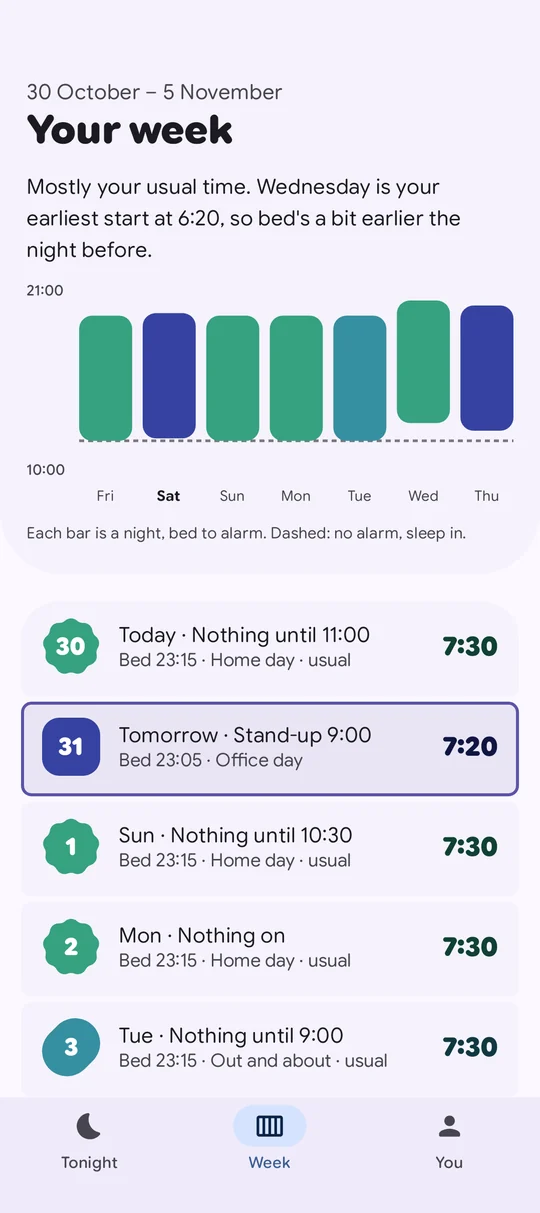
An early meeting or a dentist appointment can bring the alarm forward: free asks you first, and with Pro it moves by itself. Nothing on your calendar can make it later than your usual time, so a late start never becomes a lie-in by accident.
Bedtime moves by an hour at most
Before an early start, bedtime comes earlier, but never by more than an hour. You can't fall asleep on command, so a bigger jump would only mean lying awake. If an early start would still leave you short, it tells you.
Very early starts are eased in
When it knows two days ahead about a start an hour and a half or more before your usual time, it moves bedtime up to 30 minutes a night over a few nights, instead of all at once.
Lie-ins stay within an hour
On free days, the times it suggests stay within an hour of your usual time. A weekend lie-in, still steady.
A bedtime even with no alarm
On a day off it still gives you a time to be in bed, because that keeps your body clock steady for the days you do need an alarm.
It changes your usual times only with your say-so. If it notices you're getting up later than your alarm week after week, it asks whether to move it, in small steps. With Pro, You shows how steady your sleep has been over the last two weeks, and the sleep coach points out when weekend lie-ins are shifting your body clock.
If you work shifts
Shifts move your sleep around, and no app can make a rota regular. First Thing doesn't score how steady your sleep is when you work shifts. It plans day sleep after nights, gets you back to days after the last one, and keeps your days off steady. See First Thing for shift workers.
Keeping it steady yourself
Get up at the same time, weekends included. A steady wake time is the most useful habit for your body clock. If you lie in, keep it to an hour or so.
Get daylight soon after you're up. Morning light is the strongest signal your body clock has. Open the curtains, or get outside for a few minutes.
Move bedtime gradually. For an early start, bring bedtime forward a little over a few nights rather than trying to fall asleep two hours early.
After a bad night, get up at your usual time anyway. Sleeping in to make up for it pushes tomorrow night later too.
Steady, unless the day needs otherwise
First Thing starts from your usual time every morning, brings it earlier only when a morning needs it, and eases bedtime by an hour at most. For Android and Wear OS.

Questions
Is it bad to wake up at different times?
An occasional early or late morning is fine. It's large swings week after week, like long lie-ins every weekend, that work against your body clock.
How long can I lie in at the weekend?
Keeping it to about an hour is a good rule. First Thing's lie-in suggestions stay within an hour of your usual time.
Should I go to bed at the same time every night too?
It helps. A steady wake time sets your body clock, and a steady bedtime makes sure you get enough sleep before it. First Thing plans bedtime from tomorrow's alarm, so the two stay together.
I'm tired however much I sleep. What should I do?
Talk to your GP. Feeling tired all the time can have causes an alarm can't fix.
Sources: NHS Every Mind Matters, how to fall asleep faster and sleep better. Windred DP et al. Sleep regularity is a stronger predictor of mortality risk than sleep duration: a prospective cohort study. Sleep, 2024.